
Most of us think of a fibre-optic cable as a quiet, passive pipe for high-speed internet. It sits inside walls, runs along corridors, and loops neatly inside a plastic junction box near the router. You would not normally suspect a strand of glass of listening to a conversation. Yet a study presented at the NDSS Symposium 2026, and reported in April 2026, shows that ordinary fibre-optic cables can pick up spoken words, typing, and even coughing without any microphone placed in the room.
What happened
Researchers from Hong Kong Polytechnic University and the Chinese University of Hong Kong demonstrated that standard fibre-optic cables can be turned into remote microphones. Their work, presented at NDSS Symposium 2026, did not rely on hiding a powered bug or wireless transmitter inside the target room. Instead, the team used the glass fibre itself as the sensing element.
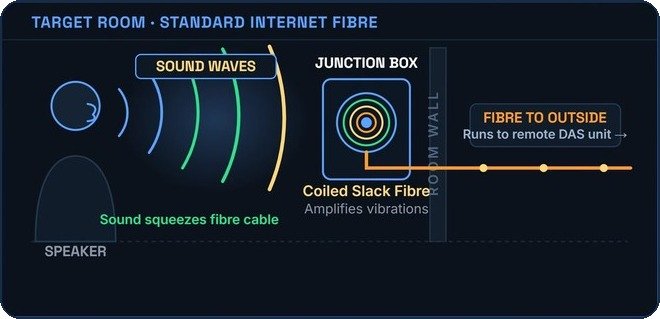
To boost the tiny vibrations produced by human speech, the researchers also tested a small device they called a “sensory receptor”. Physically, it is simply a cylinder with optical fibre wound tightly around it. Because it contains no batteries, chips, or radio parts, it can easily look like a normal fibre junction box mounted on a wall or tucked next to networking equipment.
How a glass fibre “hears” sound
The physics behind this is surprisingly straightforward for anyone studying electronics or optics. When you speak in a room, your voice creates sound waves in the air. Those waves travel through surfaces such as walls, desks, and cable enclosures, and they slightly squeeze and stretch the glass fibre running nearby.
Inside that glass fibre, laser light is travelling along the core. Even a microscopic squeeze or stretch changes the path of the glass just enough to alter the phase of the laser light inside. Some of that light naturally scatters back along the fibre towards its source.
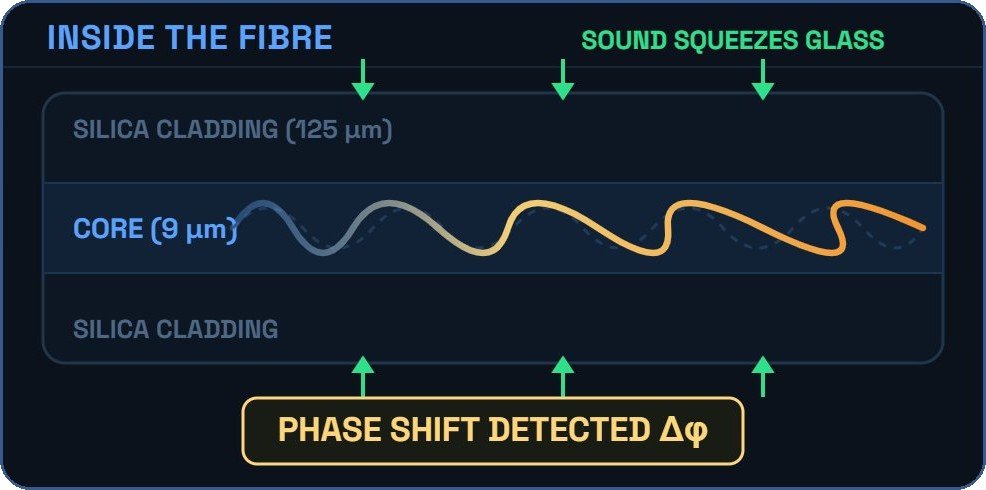
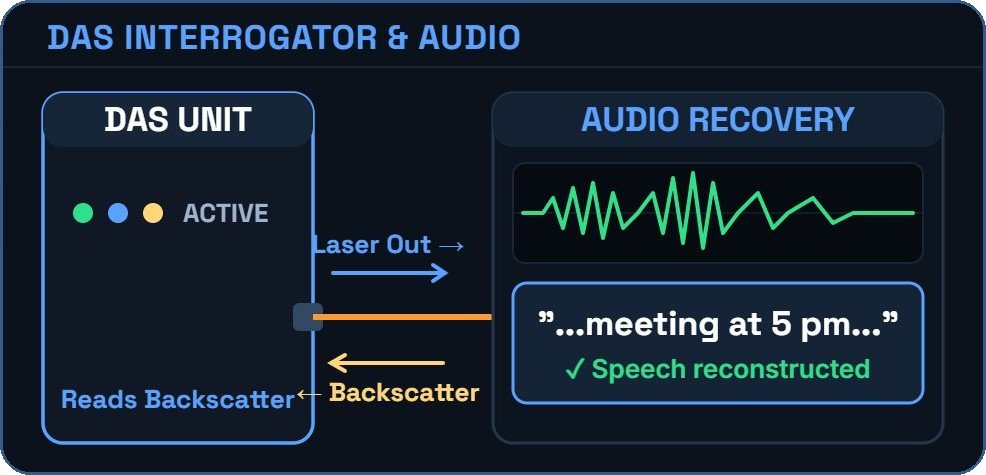
At one end of the cable, a commercial Distributed Acoustic Sensing (DAS) unit sends laser light down the fibre and reads those tiny phase changes in the backscattered light. Once the DAS unit measures how the phase shifts over time, it converts those optical changes back into an audio signal. When the fibre is wound tightly around a cylinder in a sensory receptor, more glass length reacts to the same vibration, which amplifies the effect and makes the recovered sound clearer.
What the researchers recovered
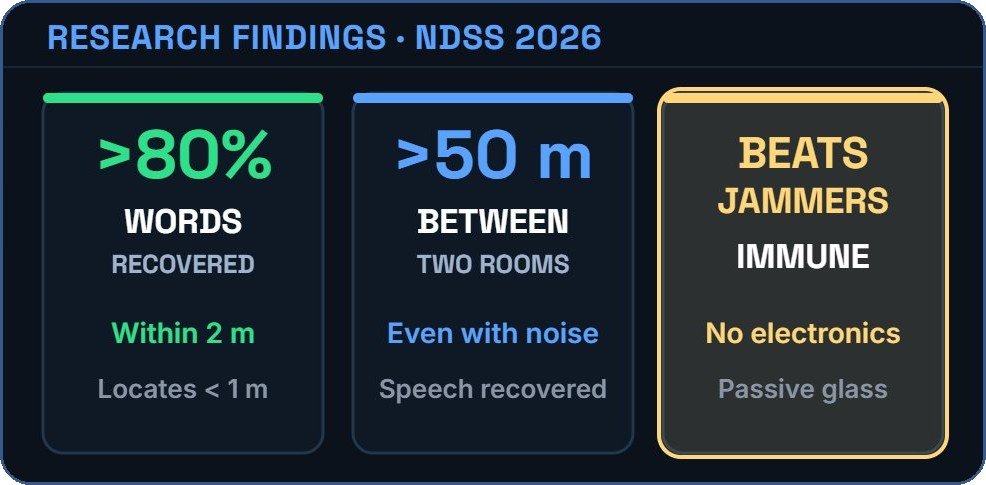
The lab results show that this is more than a vague rumble on a waveform. According to the reported findings from the research team, the system achieved several notable outcomes:
- Spoken words at close range: The setup recovered more than 80% of spoken words within 2 metres.
- Listening across rooms: Speech was recovered between two rooms linked by more than 50 metres of fibre, even when background noise was present.
- Locating the speaker: The system could pinpoint the sound source to under 1 metre inside a room.
- Non-speech sounds: Beyond voices, the fibre setup also detected everyday room sounds such as typing and coughing.
- Resistant to ultrasonic jammers: Standard ultrasonic jammers are built to overwhelm electronic microphones, so they do not stop this method because there are no electronics near the victim.
At the same time, the researchers noted clear physical limits. Audio quality drops as distance increases and as background noise grows louder. Results also depend heavily on how well vibrations travel through the room’s walls, desks, and mounting surfaces into the fibre itself.
Who could do this (and who can’t)
Before you start unplugging your home router, it helps to separate real risk from unnecessary worry. This is not something a random stranger on the internet can trigger remotely through a webpage or a software bug. To run this kind of eavesdropping, someone needs physical or network access to the fibre so they can connect a commercial DAS unit at one end of the line.
In practical terms, that points to threats with physical reach into the cabling infrastructure—such as an insider or a contractor who handles building lines. The most realistic targets mentioned in the research are:
- Fibre-to-the-home (FTTH) lines running into apartments, offices, or labs.
- Unused “dark fibre” already installed inside a building or campus conduit.
- Spare cable coiled in wall boxes, where extra loops of fibre naturally act a bit like a vibration pickup.
Because a DAS unit requires access to the fibre path and audio quality fades with distance and noise, casual attackers without physical access cannot pull this off.
How to protect your space
If you work in a sensitive office, a research lab, or a meeting room where privacy matters, you do not need exotic gadgets to reduce the risk. Good physical cabling hygiene goes a long way. Experts suggest four practical steps:
- Keep spare fibre coils away from rooms where you talk: Avoid storing coiled slack inside meeting rooms or right behind desks.
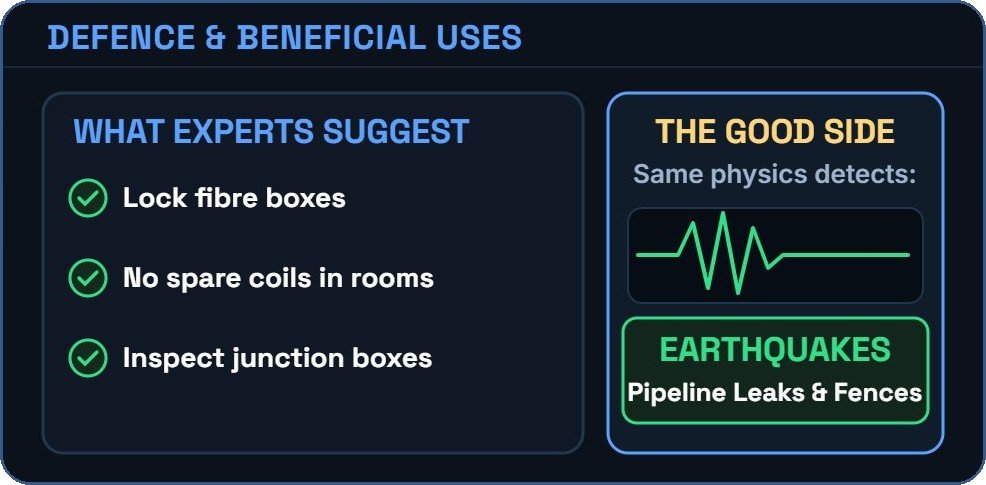
- Lock fibre boxes: Keep distribution panels and wall junction boxes physically locked so unauthorised people cannot tap into a line.
- Check for unknown junction boxes: Inspect wall boxes periodically and verify that every enclosure on your run belongs there, since a wound-fibre sensory receptor can blend in like a normal box.
- Use armoured or isolated cable runs in sensitive rooms: Mechanical isolation and armoured routing help reduce how easily room vibrations couple into the glass fibre.
The good side: fibre that listens to earthquakes
It is worth remembering that the underlying physics here was not invented for spying. Distributed Acoustic Sensing on optical fibre has been used for years in helpful, large-scale engineering work. Because a single fibre cable can act as a long chain of vibration sensors, engineers use DAS on existing fibre runs to detect earthquakes, spot pipeline leaks early, monitor trains along rail corridors, and detect intruders on perimeter fences. For engineering students, it is a great reminder that the exact same sensor principle can protect infrastructure or create a security risk, depending on who controls the hardware.
How we can help
At Saanvik Noventra, our electronics lab in V.V. Nagar, Anand, works with students, makers, and teams who want to turn sensor ideas into real hardware. We build sensors, PCBs, and prototypes—from early circuit design to working bench units you can test and refine. If you are working on an engineering project, a custom sensing board, or a hardware prototype and want a hand getting it built properly, message us on WhatsApp at 84605 18625 or follow our lab updates on Instagram at Build with SN.